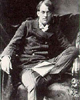
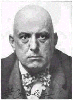
 (pronounced to rhyme with “unholy”, not “foully”) (1875-1947)
(In)famous magician of the Victorian and Edwardian eras, influential in the Golden Dawn and O.T.O., and founder of the A∴A∴ Descriptions of Crowley are usually biased, since most people either adore(d) him or hate(d) him – and he deliberately encouraged such controversy. Calling himself “The Great Beast 666” (including having it put on his business cards) and “Master Therion” (to mega therion (το μεγα θηριον) is Greek for “the great beast”), he shocked and scandalized polite society and the lower classes alike, and became notorious for cocaine use, sexual excess, and similar Byronically outré practices. His philosophy of thelema, derived partially from Rabelais, emphasized the primacy of individual will. Books such as Magick in Theory and Practice, The Book of the Law, Liber AL vel Legis, and The Book of Lies, were often spiced with provocative asides and blinds that were calculated to cause maximum furor (such as his blithe claim to have sacrificed “a male child of high intelligence” at least 150 times a year over a period of 10 years – a coded reference to magickal masturbation, but liable to be taken at face value by the average reader!).
However, despite (or perhaps partially because of) his provocative and attention-seeking nature, he was a superlative magician. Though he did not found the O.T.O., he did eventually take it over and reform it to the extent that it is generally thought of as “his” organization, and the modern O.T.O. is a thoroughly Crowleyan tradition. Though charisma doubtless played some part in this, a great share of the credit must also go to his acknowledged magickal skill. He also formulated the definition of magick as “the art and science of causing change to occur in conformity with Will” that still stands as the best – indeed, this definition is even promulgated by some occultists who otherwise despise and loathe Crowley himself! It’s also worth pointing out that his Thelemic Law, when properly understood, is not intended to be a license for universal freedom. (However, Crowley must have known that its usual phrasing would be misinterpreted...) He also compiled 777, an exhaustive compendium of Qabalistic correspondence tables, which is still invaluable to Qabalistic and hermetic practitioners.