Tree of Life
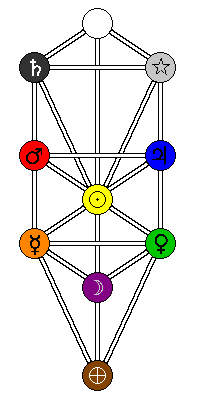 Primary symbol in Qabala – indeed, the glyph around which much of Qabalism is based. The basic arrangement of the Tree of Life (or, in Hebrew, איץ החים or aitz ha-chayim) is that of ten “spheres” (singular sephira, ספירא; plural sephiroth) arranged in a descending zig-zag pattern and connected by 22 “paths”. Each sephira is said to represent a different “emanation of Godhood”, or a basic quality of the Universe. In Jewish mysticism, these are given the names:
- Kether (כתר) “Crown”
- Chokmah (חכמה) “Wisdom”
- Binah (בינה) “Understanding”
- Chesed (חסד) “Mercy” – also called Gedulah (גדולה) “Greatness”
- Geburah (גבורה) “Power, Severity”
- Tiphereth (טפרת) “Beauty”
- Netzach (נצח) “Victory”
- Hod (הוד) “Splendor”
- Yesod (יסוד) “Foundation”
- Malkuth (מלכות) “Kingdom”
There’s a standard mnemonic for remembering all these: “I seek the Crown of Wisdom and Understanding, that Mercy and Strength in balance may bring Beauty. Victory and Splendor find their Foundation in the Kingdom (of the Tree of Life).” This formula recapitulates the Qabalistic view of Creation. Alternatively, since we are material creatures in the sphere of Malkuth, those trying to rejoin Godhood may use: “The Kingdom finds its Foundation in Splendor and Victory. Beauty is the balance of Strength and Mercy. Understanding and Wisdom will lead me to the Crown.”
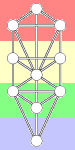
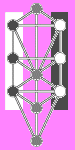
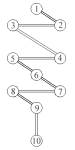
Qabalists have a variety of ways of dividing up the Tree, including the Four Worlds, the Three Pillars, and so on. These are diagrammed below.
 |
 |
 |
|
| The Four Worlds |
The Three Pillars |
Numbers of the Sephiroth
and the Cosmic Lightning |
|
For ceremonial magicians, the Tree of Life is a primary source of many correspondences. The ten sephiroth can correspond to any of various things – the image at the top of this page shows seven of them corresponding to the seven classical astrological “planets” (Sun, Moon, Mercury, Venus, Mars, Jupiter and Saturn), with others corresponding to Earth, the Fixed Stars, and Godhood. The 22 paths easily correspond with the 22 letters of the Hebrew alphabet and with the 22 Major Arcana of the Tarot. Crowley’s book 777 is primarily a table of Qabalistic correspondences.
<& ./navbar.m &>